- 21297 Foothill Blvd, Ste 203 Hayward, CA 94541 (by appointment only)
- (415) 636-9700
- hello@exxceedwellness.com

You walk into the kitchen and forget why. Someone tells you their name, and ten seconds later it’s gone. If this started with depression, you’re not imagining it. There’s a physical reason, and it shows up on brain scans.
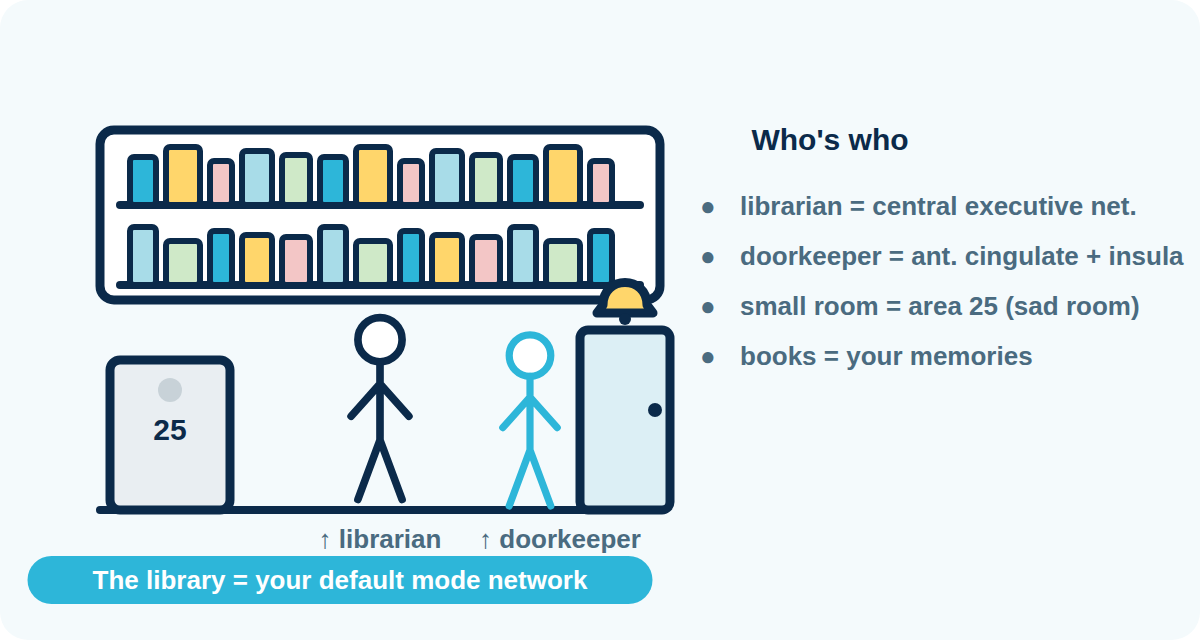
Every memory you have is a book. The library that holds them is a brain system called the default mode network. It’s most active when you turn inward to remember or daydream, and it builds stories out of what’s on the shelves (Buckner et al., 2008).
Running the library is a librarian. She files new books, finds the one you ask for, and decides which story gets your attention. In the brain, she’s the central executive network, just behind your forehead: the part you use to focus and think things through (Buhle et al., 2014).
At the front door sits a doorkeeper with a bell, your anterior cingulate cortex and insula. When something out in the world needs you, the bell rings and your attention turns outward (Seeley et al., 2007; Sridharan et al., 2008).
And in the back is a small room called area 25. It’s the room where you withdraw, rest, and pull back, so we’ll call it the sad room. When something sad happens, the sad room switches on, you slow down for a while, and then it switches off (Mayberg et al., 1999).
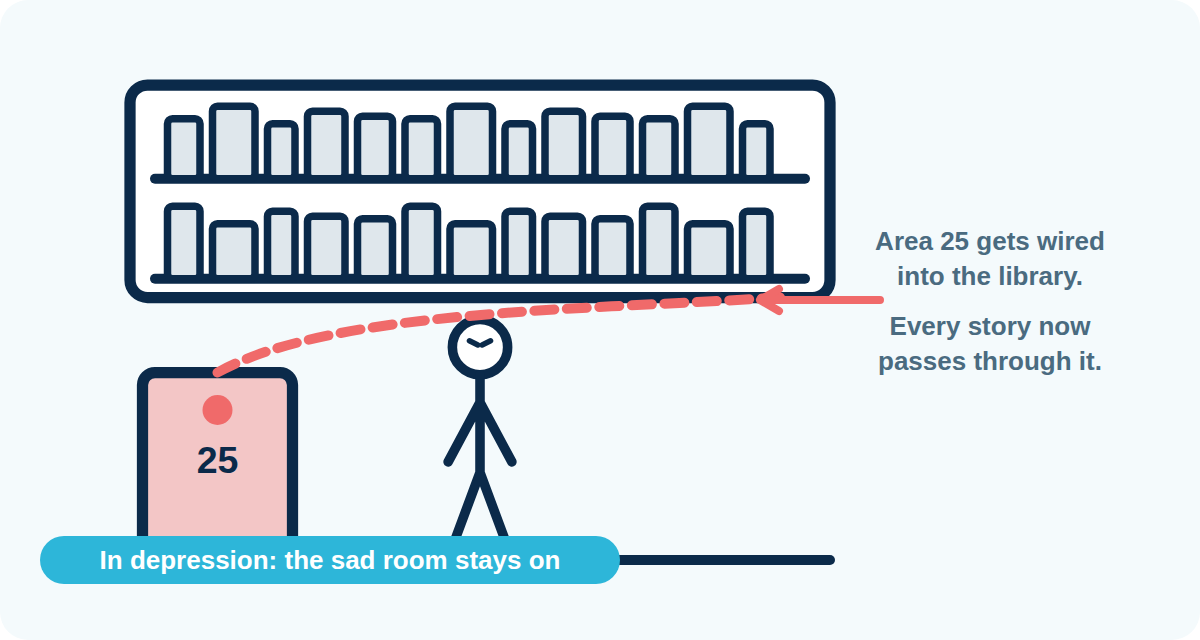
In depression, the sad room stays on, and it gets wired straight into the library (Hamilton et al., 2015). Every story the library tells now runs through it. The stories turn sad, and they’re all about you. Whatever happens around you becomes about you.
Meanwhile, the librarian wears down. Brain scans show her network gets weaker in depression while the library’s grows stronger, tipping the brain toward inner thoughts “at the cost of engaging with the external world” (Kaiser et al., 2015). Instead of checking the sad stories, she gets pulled into them. Her part of the brain also has fewer connections between cells, and fewer connections go with deeper depression (Kang et al., 2012; Holmes et al., 2019).
Think back to that name. The doorkeeper rings: pay attention, this matters. But the librarian is buried in a sad story, so the name never gets filed. Same with the kitchen. The reason you walked in never made it onto a shelf.
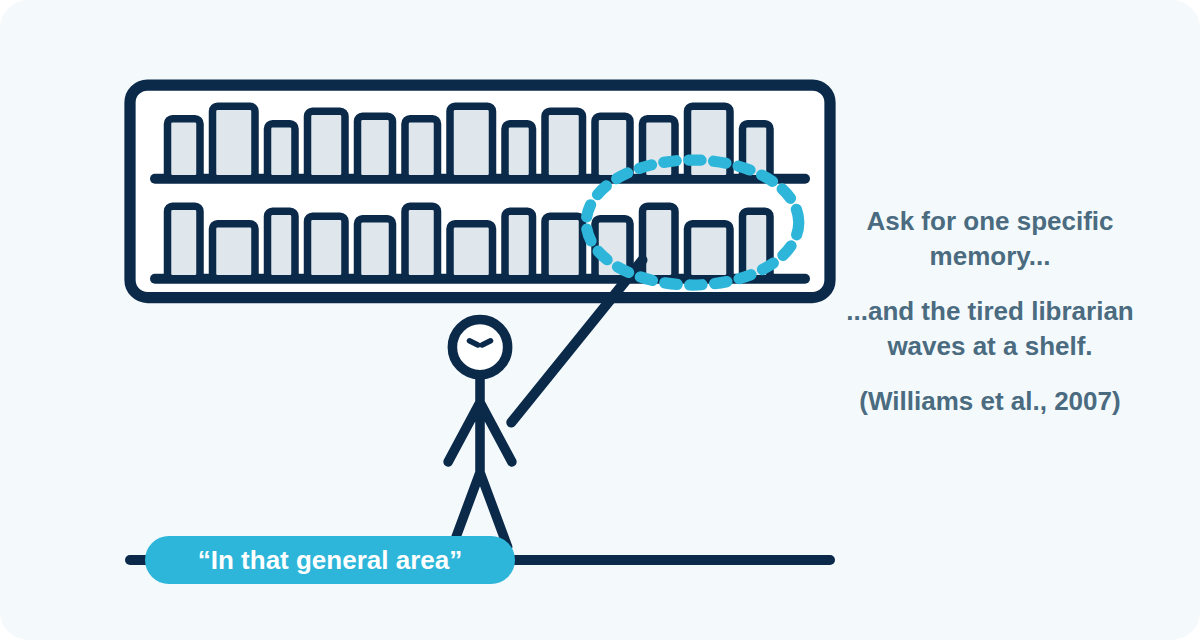
Older memories blur too. Ask for one specific day, and the tired librarian waves at a shelf: “somewhere in that general area.” People with depression really do answer this way (Williams et al., 2007).
That’s why researchers now count memory and focus problems as a core part of depression, apart from low mood (Rock et al., 2014).
The books are all still there. What needs work is the librarian, and she gets stronger the way a muscle does: reps.
Talk therapy is rep after rep of noticing a story and stepping back from it. Doing small things even when you don’t feel like it counts too. That approach, called behavioral activation, worked as well as full cognitive behavioral therapy in a trial of 440 people (Richards et al., 2016).
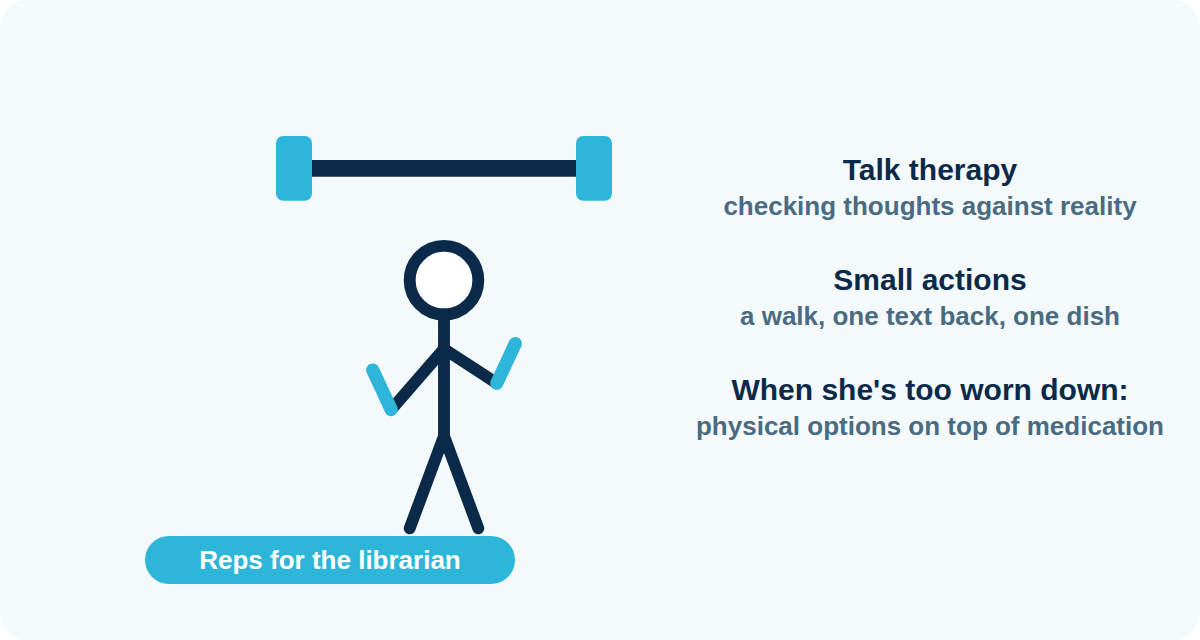
Every rep above is aimed at one thing: a stronger librarian. Talk therapy is practice at exactly this, rep after rep, with a guide. Medication helps many people too: in a review of 522 trials, every antidepressant studied worked better than a placebo (Cipriani et al., 2018). For a lot of people, that’s enough.
For some, it isn’t. If two or more antidepressants haven’t moved the needle, clinicians call that treatment-resistant depression, and there are options that work on the librarian’s wiring more directly, on top of medication.
To see why they work, picture a seesaw. The librarian’s home behind your forehead and the sad room, area 25, move in opposite directions: when one goes up, the other goes down (Mayberg et al., 1999). In depression, the sad room is up and the librarian is down. Both treatments push on that seesaw.
Spravato is a nasal spray related to ketamine. It works on the hardware. In animal studies, ketamine regrew lost connections between brain cells in the front of the brain, the librarian’s part, and those new connections were what kept the improvement going (Moda-Sava et al., 2019). In people who hadn’t improved after at least two antidepressants, adding Spravato led to more improvement within four weeks (Popova et al., 2019).
Transcranial Magnetic Stimulation (TMS) aims magnetic pulses at the librarian’s home, area 46, and it asks a bit more of you: sessions at a clinic over several weeks, and some discomfort while the pulses tap. The spots that work best are the ones most tightly tied, in opposite directions, to the sad room (Fox et al., 2012). In brain scans taken before and after a course of TMS, the sad room’s grip on the library loosened (Liston et al., 2014). In real-world clinics, 58% of people who hadn’t improved with antidepressants responded, and 37% went into remission (Carpenter et al., 2012).
Every option here points the same way as the reps: the sad room quiets, the librarian comes back, and new things start getting filed again. If your memory changed along with your mood, tell a mental health clinician. The good news is that memory tends to come back as depression lifts (Rock et al., 2014).
Prefer to watch? The short is above. The full video, with the whole library story, is here.
Educational information only, not medical advice. If you are in crisis, call or text 988.