- 21297 Foothill Blvd, Ste 203 Hayward, CA 94541 (by appointment only)
- (415) 636-9700
- hello@exxceedwellness.com

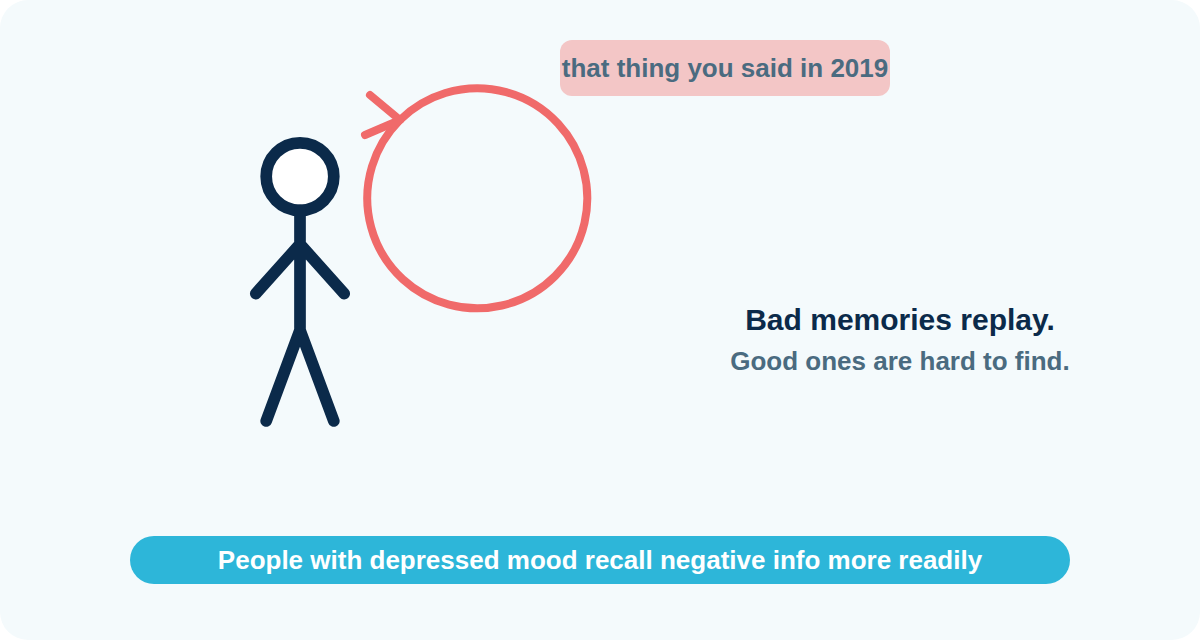
It’s 2 a.m. and your brain starts a highlight reel. Every clip is the worst one: the thing you said in 2019, the look on someone’s face, the moment you messed up. On a loop.
Ask that same brain for a good memory, and it comes up empty.
People with depressed mood recall negative information more readily, while people without depression lean toward the positive (Gaddy & Ingram, 2014). So when your mind reaches for a memory, the painful ones sit on the front shelf.
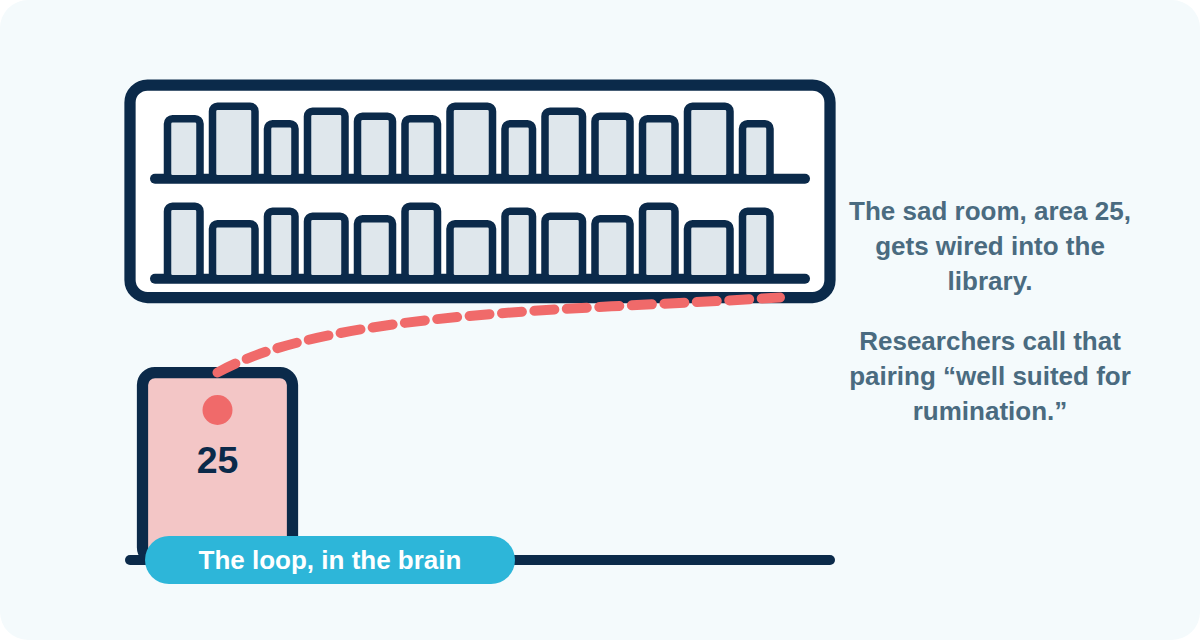
Picture your mind as a library. The shelves are the default mode network, the brain system that replays the past and imagines the future (Buckner et al., 2008). It’s how you learn from mistakes and plan ahead.
In the back is a small room called area 25. It’s the room where you withdraw, rest, and pull back, so we’ll call it the sad room. When something sad happens, it switches on, you slow down for a while, and then it switches off (Mayberg et al., 1999).
In depression, the sad room gets wired into the library. Researchers describe that pairing as well suited for rumination, going over the same painful thoughts again and again (Hamilton et al., 2015). Every story now runs through the sad room, and they’re all about you. In brain scans, the more the library took over, the more people got stuck in the brooding kind of rumination (Hamilton et al., 2011).
At the library’s front door sits a doorkeeper with a bell, your anterior cingulate cortex and insula. Its job is to flag what matters right now. When someone is depressed, the insula is more tightly linked to the brain’s sad centers, and more so in people with more severe depression (Avery et al., 2014). So the old memory rings the bell, “this matters, look again,” and the doorkeeper keeps answering.
Rumination is usually your mind trying to solve something. Why did that happen? Why am I like this? The trouble is the kind of question. Big, abstract “why” questions keep the loop spinning. Small, concrete ones tend to help (Watkins, 2008). The loop also has a cost: it makes problem-solving harder and pulls people away from the friends who’d help (Nolen-Hoeksema et al., 2008).
When the 2 a.m. reel asks “Why am I like this?”, you don’t have to answer. Rumination feels like you’re finally figuring yourself out, and that feeling is part of the trap: in studies, depressed people who ruminated believed they were gaining insight, so they turned down activities they knew they’d enjoy (Lyubomirsky & Nolen-Hoeksema, 1993).
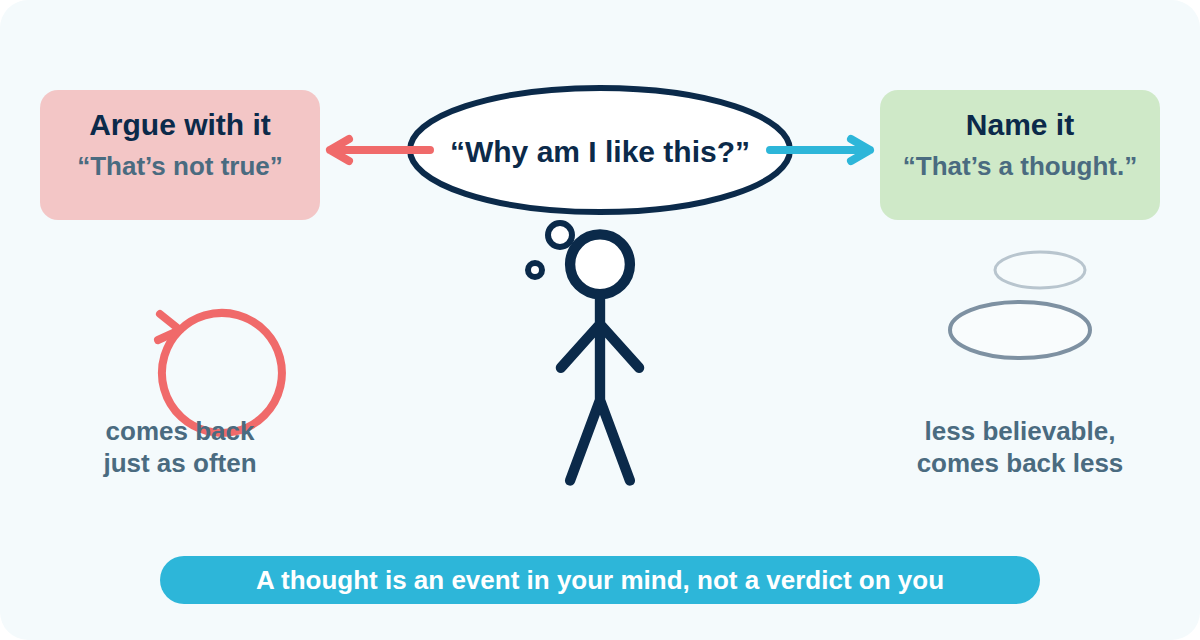
Don’t argue with it either. “That’s not true” sounds like a defense, but it keeps you in the game. In one study, people who spent five days arguing with a negative thought kept having it just as often. People who stepped back from it had it less (Larsson et al., 2016). Trying to push a thought away backfires too: suppressed thoughts tend to bounce back (Abramowitz et al., 2001).
What works is one short line that treats the thought as a thought: “That’s a thought.” Nothing more. Not true, not false, not a verdict on who you are. It’s an event in your mind, like a sound in the room. In a trial of people with depression, that shift is what made the difference. They got better because they related to their thoughts differently, even though the negative thoughts kept showing up (Zettle et al., 2011). And people who could see their thoughts as passing mental events were less likely to fall back into depression later (Teasdale et al., 2002). Therapists call this defusion.
If a thought won’t loosen its grip, shrink it to one word, like “failure,” and say it quickly under your breath for about thirty seconds. It turns into a sound. In studies, the word got less upsetting within seconds and less believable within half a minute, and this worked better than distraction, including for people with higher depression scores (Masuda et al., 2008; Masuda et al., 2010).
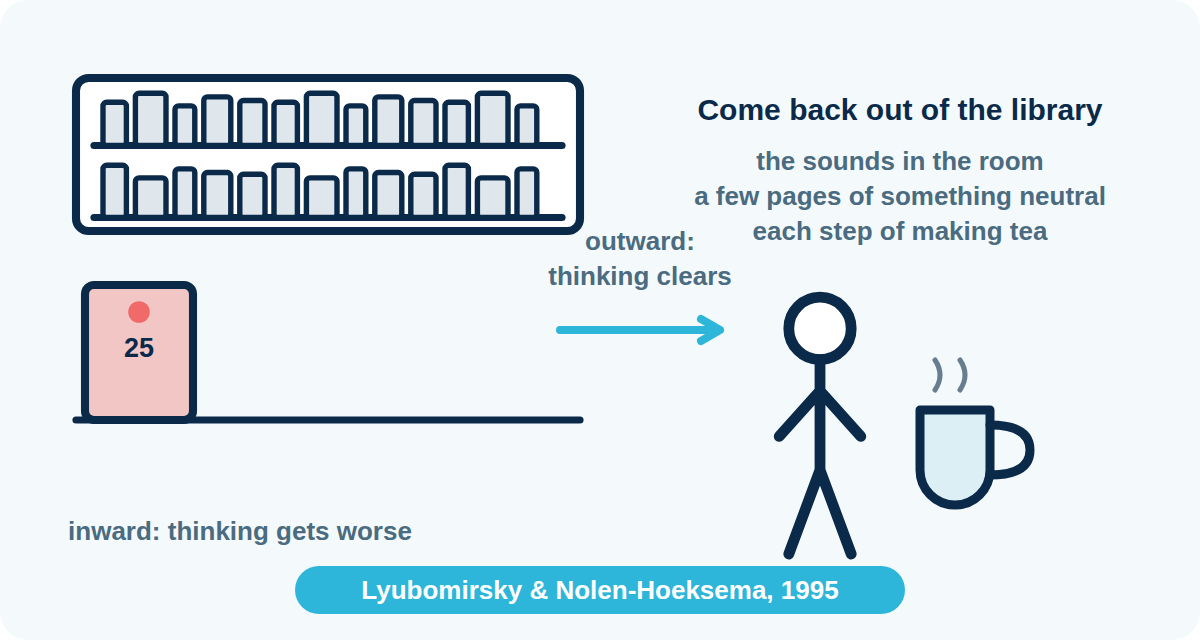
Most of what the reel replays can’t be fixed, and doesn’t need to be. So the next move isn’t solving. It’s turning your attention outward: the sounds in the room, a few pages of something neutral, each step of making tea. In studies, depressed people who turned outward like this thought as clearly, and solved problems as well, as people without depression. The ones who kept turning inward got worse (Lyubomirsky & Nolen-Hoeksema, 1995). This is the doorkeeper’s job, turning you toward the world, and the librarian, your central executive network behind your forehead, is who follows the bell.
If there is something real to do, take the smallest physical step, like drafting the two lines you’ll send tomorrow. Practicing that switch from abstract questions to concrete steps eased depression and cut rumination in a trial of people with major depression (Watkins et al., 2012).
Rumination works like a habit. The same time, the same bed, the same mood cue it up (Watkins & Nolen-Hoeksema, 2014). Habits fade when you keep answering the cue a new way. Mindfulness-based cognitive therapy trains exactly this response, noticing a thought and not following it, and people who completed it had about a third lower risk of their depression coming back over the following year or so (Kuyken et al., 2016). The pull won’t vanish overnight, but each time you catch it, it gets a little fainter.
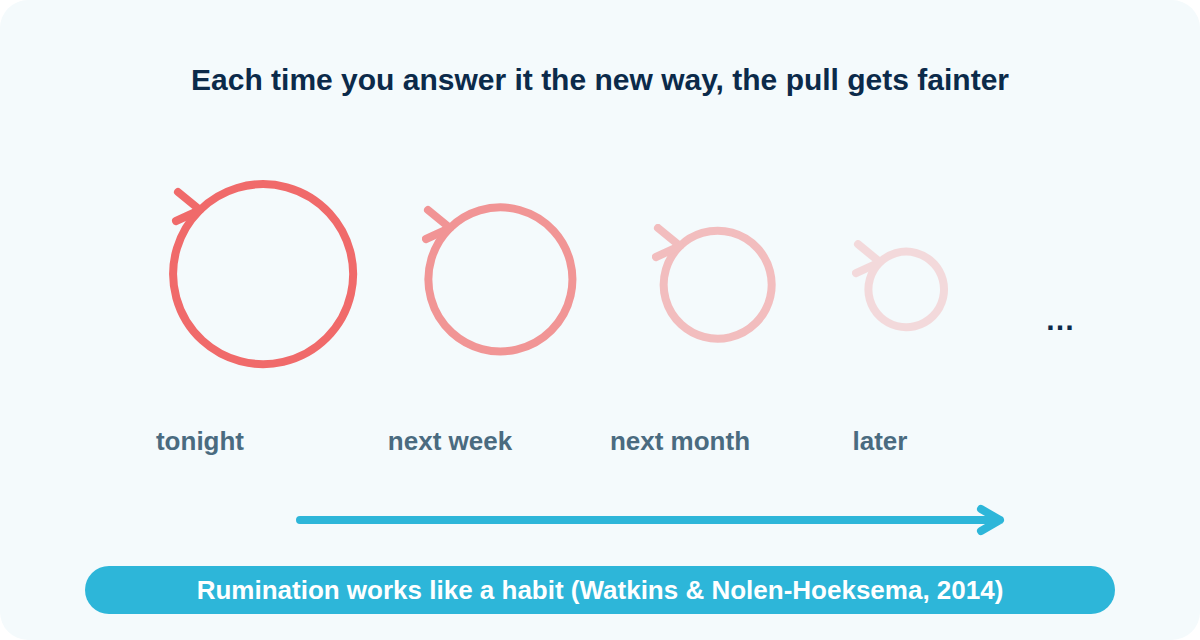
Every time you answer the reel the new way, that’s a rep for the librarian. Talk therapy is practice at exactly this, rep after rep, with a guide. Medication helps many people too: in a review of 522 trials, every antidepressant studied worked better than a placebo (Cipriani et al., 2018). For a lot of people, that’s enough.
For some, it isn’t. If two or more antidepressants haven’t moved the needle, clinicians call that treatment-resistant depression, and there are options that work on the librarian’s wiring more directly, on top of medication.
To see why they work, picture a seesaw. The librarian’s home behind your forehead and the sad room, area 25, move in opposite directions: when one goes up, the other goes down (Mayberg et al., 1999). In depression, the sad room is up and the librarian is down. Both treatments push on that seesaw.
Spravato is a nasal spray related to ketamine. It works on the hardware. In animal studies, ketamine regrew lost connections between brain cells in the front of the brain, the librarian’s part, and those new connections were what kept the improvement going (Moda-Sava et al., 2019). In people who hadn’t improved after at least two antidepressants, adding Spravato led to more improvement within four weeks (Popova et al., 2019).
Transcranial Magnetic Stimulation (TMS) aims magnetic pulses at the librarian’s home, area 46, and it asks a bit more of you: sessions at a clinic over several weeks, and some discomfort while the pulses tap. The spots that work best are the ones most tightly tied, in opposite directions, to the sad room (Fox et al., 2012). In brain scans taken before and after a course of TMS, the sad room’s grip on the library loosened (Liston et al., 2014). In real-world clinics, 58% of people who hadn’t improved with antidepressants responded, and 37% went into remission (Carpenter et al., 2012).
When the seesaw tips back, the reel loses its power source. And if you worry that all this replaying does lasting harm, the research is reassuring.
Prefer to watch? The full video, with the whole library story, is here.
Educational information only, not medical advice. If you are in crisis, call or text 988.