- 21297 Foothill Blvd, Ste 203 Hayward, CA 94541 (by appointment only)
- (415) 636-9700
- hello@exxceedwellness.com

“Is my brain broken?”
If depression has left holes in your memory, that question can sit in the back of your mind like a stone. The research on the brain’s memory center is more hopeful than the fear.
A large review found measurable trouble with memory, focus, and planning in people with depression (Rock et al., 2014). Picture memory as a library. The librarian who files and finds the books is your central executive network, behind your forehead. In depression she’s worn down and pulled into sad, inward stories, so new things don’t get filed and old ones are hard to find.
The same review looked at people whose depression had lifted. Their memory problems were smaller, small enough that they no longer stood out statistically. Trouble with focus was more likely to linger (Rock et al., 2014). That’s one reason clinicians aim for full recovery, beyond “a bit better.”
Deep in the brain sits the hippocampus, a curved, seahorse-shaped area that helps store new memories. You may have read that depression shrinks it.
The biggest study, scans from nearly 9,000 people across 15 research groups, found a difference that was real and small: about 1 to 2 percent on average. It came mainly from people with repeated episodes. People in their first episode didn’t differ from people without depression (Schmaal et al., 2016).
So the lesson is prevention. Treating depression fully, and keeping it from coming back, is what protects it.
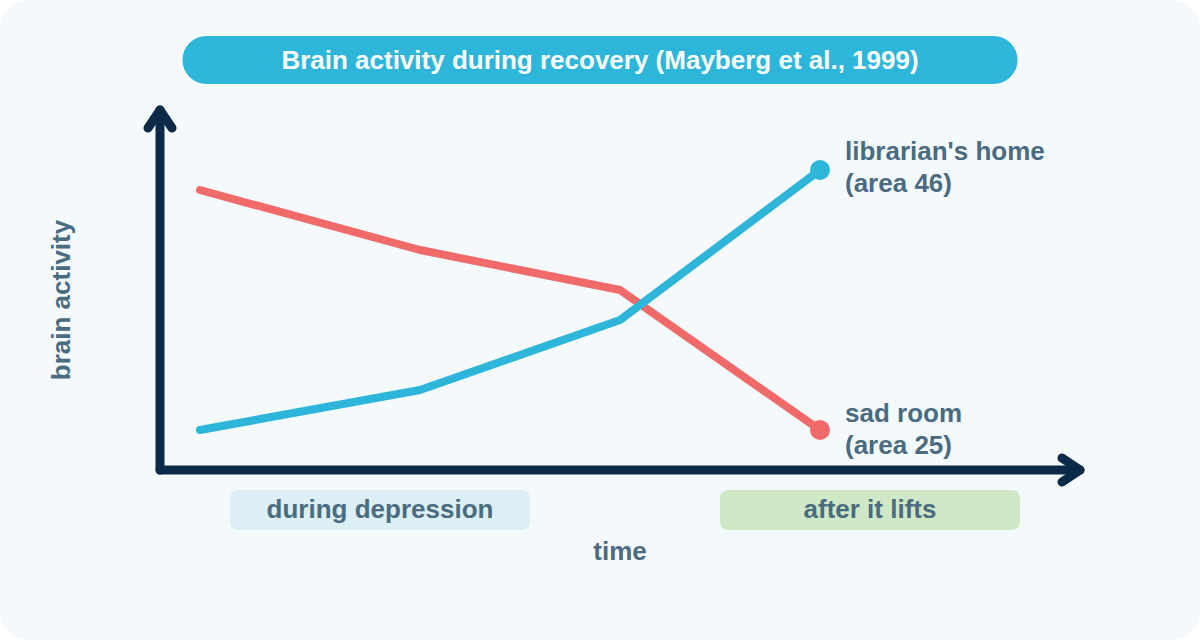
Tucked behind the library is a small room called area 25, the room where you withdraw, rest, and pull back. Call it the sad room. When researchers scanned people recovering from depression, the sad room quieted down, and activity came back up in the librarian’s home (Mayberg et al., 1999).
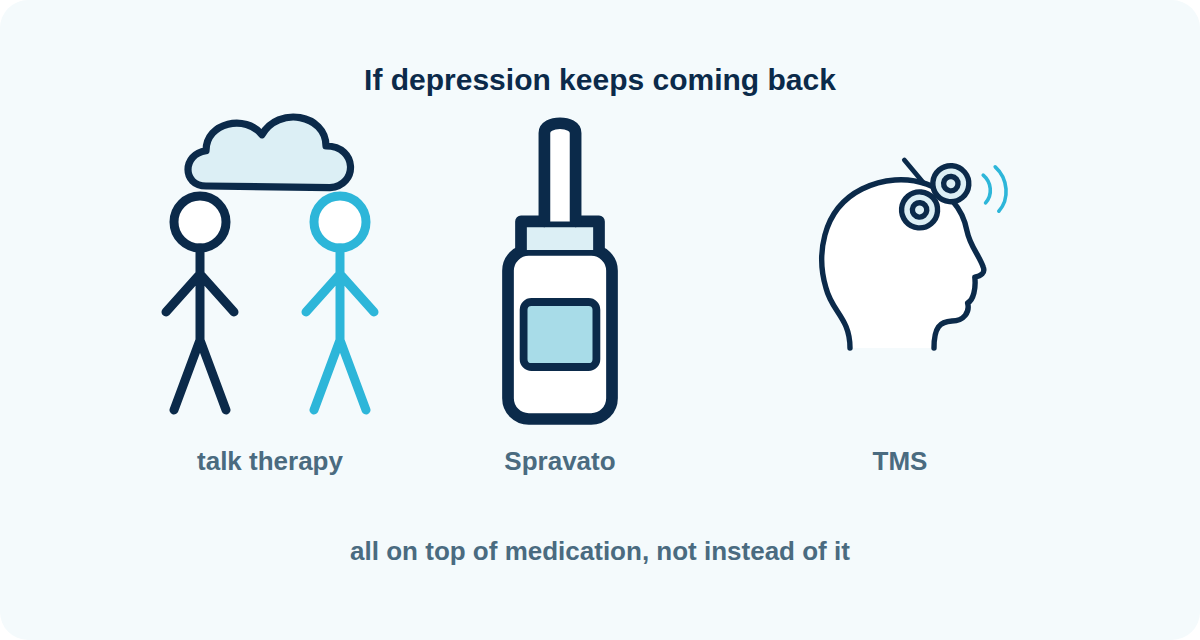
The best way to protect the memory center is to get the librarian back and keep her there. Recovery often starts with talk therapy and small daily practice, even when motivation is low. Medication helps many people too: in a review of 522 trials, every antidepressant studied worked better than a placebo (Cipriani et al., 2018). For a lot of people, that’s enough.
For some, it isn’t. If two or more antidepressants haven’t moved the needle, clinicians call that treatment-resistant depression, and there are options that work on the librarian’s wiring more directly, on top of medication.
To see why they work, picture the recovery scans above as a seesaw. The librarian’s home behind your forehead and the sad room move in opposite directions: when one goes up, the other goes down (Mayberg et al., 1999). In depression, the sad room is up and the librarian is down. Both treatments push on that seesaw.
Spravato is a nasal spray related to ketamine. It works on the hardware. In animal studies, ketamine regrew lost connections between brain cells in the front of the brain, the librarian’s part, and those new connections were what kept the improvement going (Moda-Sava et al., 2019). In people who hadn’t improved after at least two antidepressants, adding Spravato led to more improvement within four weeks (Popova et al., 2019).
Transcranial Magnetic Stimulation (TMS) aims magnetic pulses at the librarian’s home, area 46, and it asks a bit more of you: sessions at a clinic over several weeks, and some discomfort while the pulses tap. The spots that work best are the ones most tightly tied, in opposite directions, to the sad room (Fox et al., 2012). In brain scans taken before and after a course of TMS, the sad room’s grip on the library loosened (Liston et al., 2014). In real-world clinics, 58% of people who hadn’t improved with antidepressants responded, and 37% went into remission (Carpenter et al., 2012).
Different routes, same seesaw: the sad room comes down, the librarian comes back up.
So, is your brain broken? The research points to a brain under strain, and strain eases with treatment. A clinician can walk you through every option.
Prefer to watch? The full video, with the whole library story, is here.
Educational information only, not medical advice. If you are in crisis, call or text 988.