- 21297 Foothill Blvd, Ste 203 Hayward, CA 94541 (by appointment only)
- (415) 636-9700
- hello@exxceedwellness.com

Exposure therapy doesn’t delete a fear memory. It builds a second, safe memory that has to win. Here’s why fear comes back in new places, and how to stop it.
Someone faces their fear for weeks. The spider. The elevator. The presentation. It works, and the fear fades.
Then one morning, on the train to work, it’s back. Same racing heart. Same dread. As if none of the work ever happened.
Most people decide the therapy failed. The real answer is in how the brain stores fear, and it changes how exposure should be done.
Exposure therapy doesn’t erase a fear memory. It builds a second memory, a safe one, right beside it. Then the two compete.
Whichever memory the brain reaches for in the moment decides how a person feels.
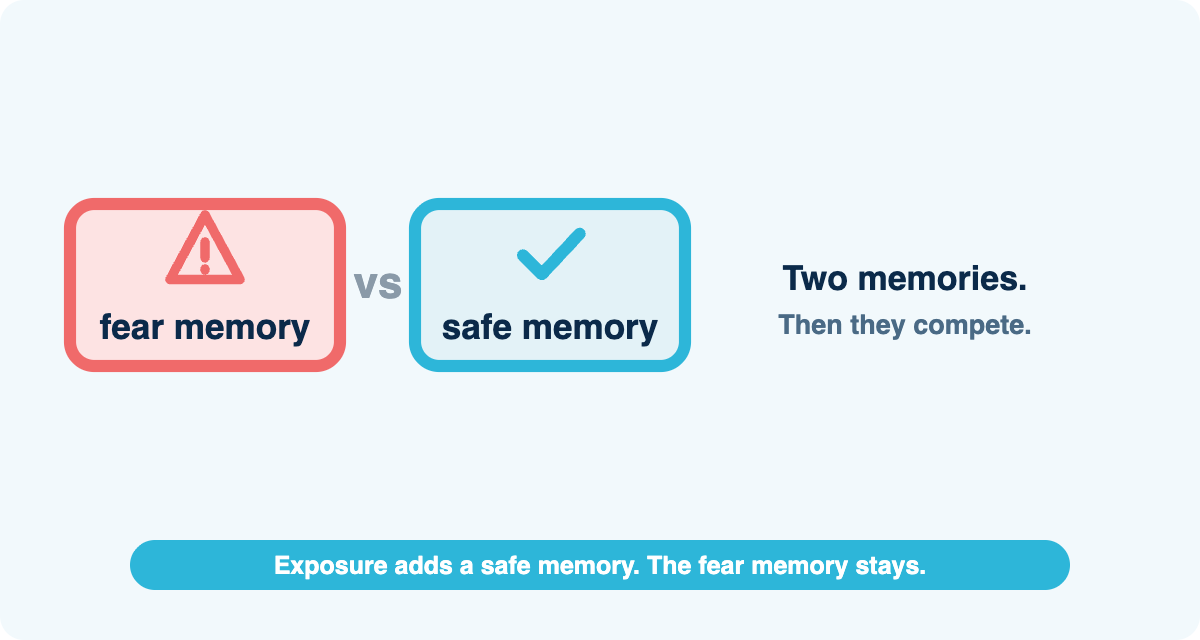
Exposure means meeting the thing you fear on purpose, again and again, while nothing bad happens. Each time, the fear drops a little.
With a phobia, the feared thing is real and right in front of you: a dog, a spider, a needle.
With anxiety, it usually hasn’t happened yet. It’s a future the brain imagines. A presentation that goes badly. A phone call with bad news.
That imagined future comes from the default mode network. It’s the brain system that runs daydreams, replays the past and plays out “what if.”
In brain scans of people with generalized anxiety, worry was tied to how strongly the hubs of this network talked to the amygdala (Makovac et al., 2018).
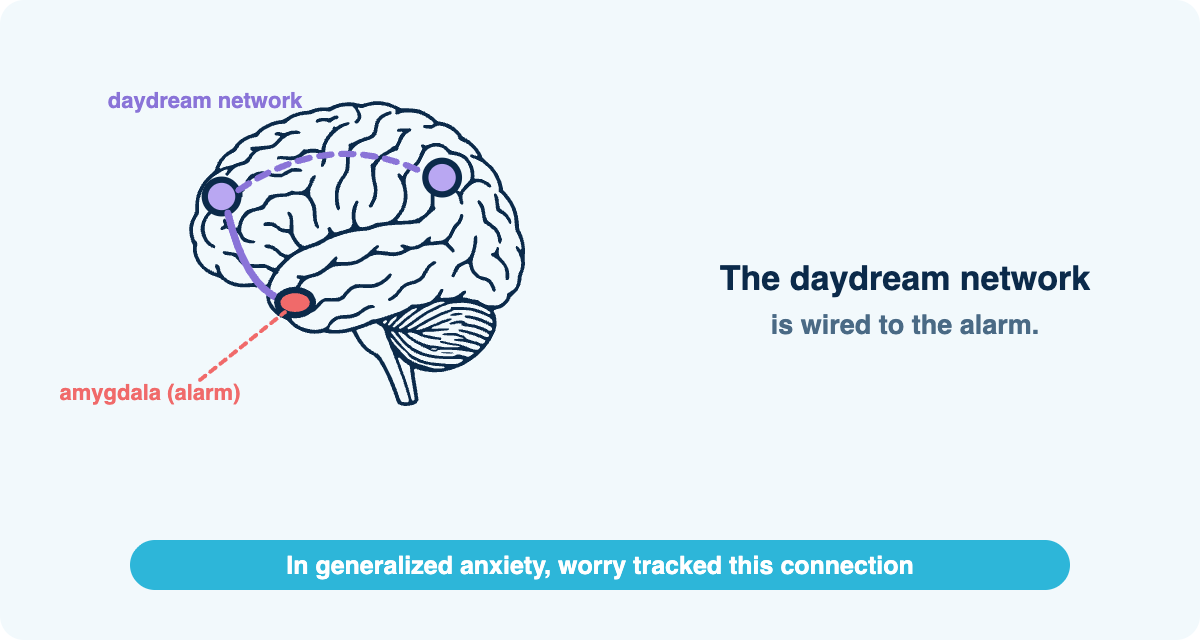
The amygdala is the brain’s alarm. It’s also where a learned fear is stored. Call that the fear memory.
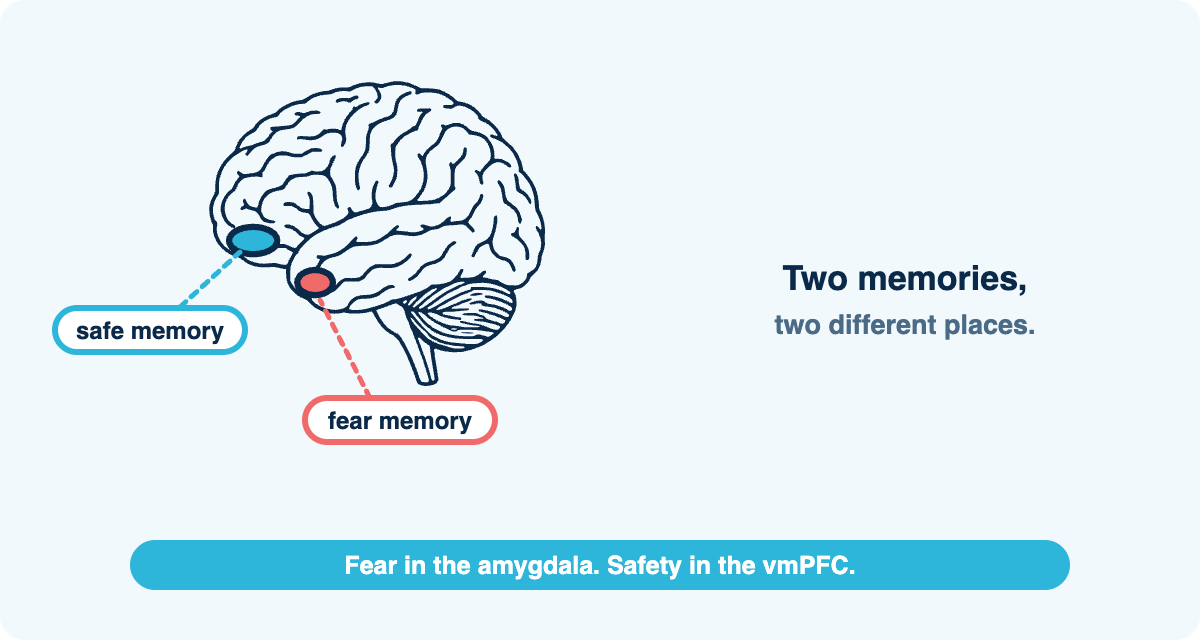
Here’s the part that surprises people. Exposure leaves the fear memory right where it is, in the amygdala.
The new learning gets stored somewhere else: the ventromedial prefrontal cortex, a patch at the front of the brain just behind the eyes. Doctors shorten it to vmPFC.
The vmPFC holds the second memory: I faced this, and nothing went wrong. Call it the safe memory.
So after exposure, there are two memories in two places:
Two experiments in rats show it.
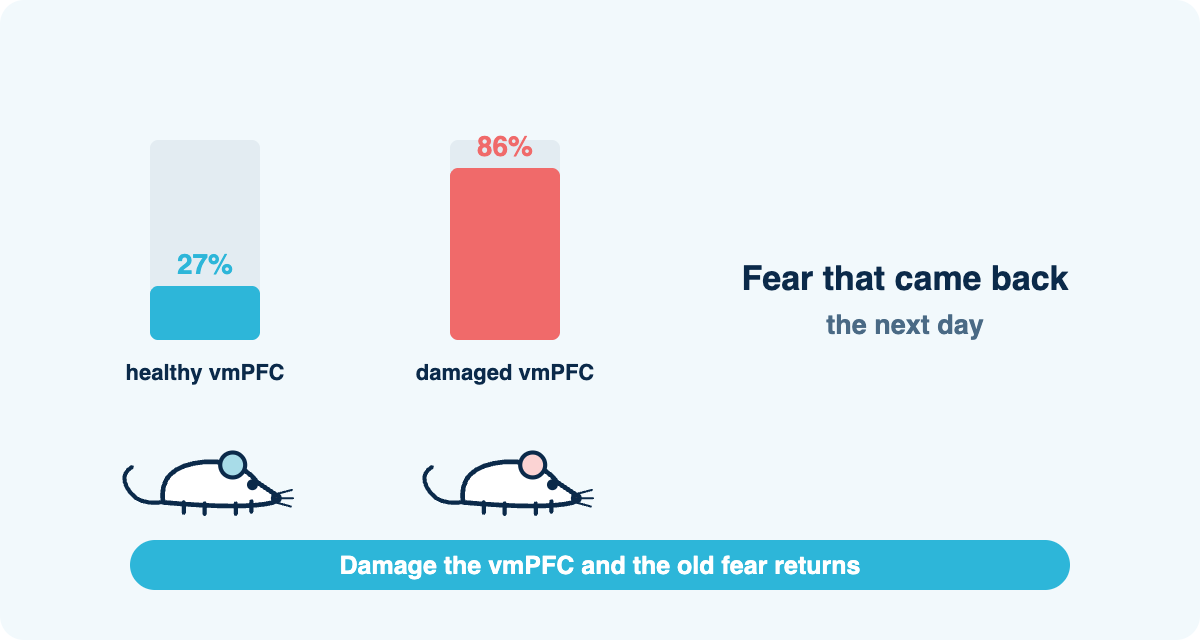
Experiment one: damage the safe memory’s home. Researchers damaged the vmPFC in rats. Then they taught the rats to fear a tone and taught them, with repeated tones and nothing bad happening, that it was safe again. The next day, rats with a healthy vmPFC showed about 27% of their old fear. Rats with a damaged vmPFC showed 86%, the same as rats that were never taught the tone was safe (Quirk et al., 2000).
Without the vmPFC, the safe memory didn’t hold, and the old fear came back almost whole.
Experiment two: switch the safe memory on. Researchers took rats that were still afraid of a tone. No exposure at all. They played the tone and, at the same moment, gave the vmPFC a tiny electrical pulse. Those rats barely froze (Milad & Quirk, 2002).
The fear memory was inside them the whole time. It got outvoted.
It builds a safe memory strong enough to win. Rep after rep, until the safe memory is more convincing than the fear.
That’s why exposure works as a kind of learning, and why it takes repetition.
Now back to the train.
The brain’s record keeper is the hippocampus. It files memories along with where they happened, when, and what the body was feeling at the time (Bouton et al., 2006).
The fear memory picked up tags from everything that happened to be around when the fear first showed up:
The safe memory, built in a therapist’s office, got one tag: the office.
So in the office, the safe memory wins. On the train, no safe memory is tagged to that place, and the fear has the floor to itself.
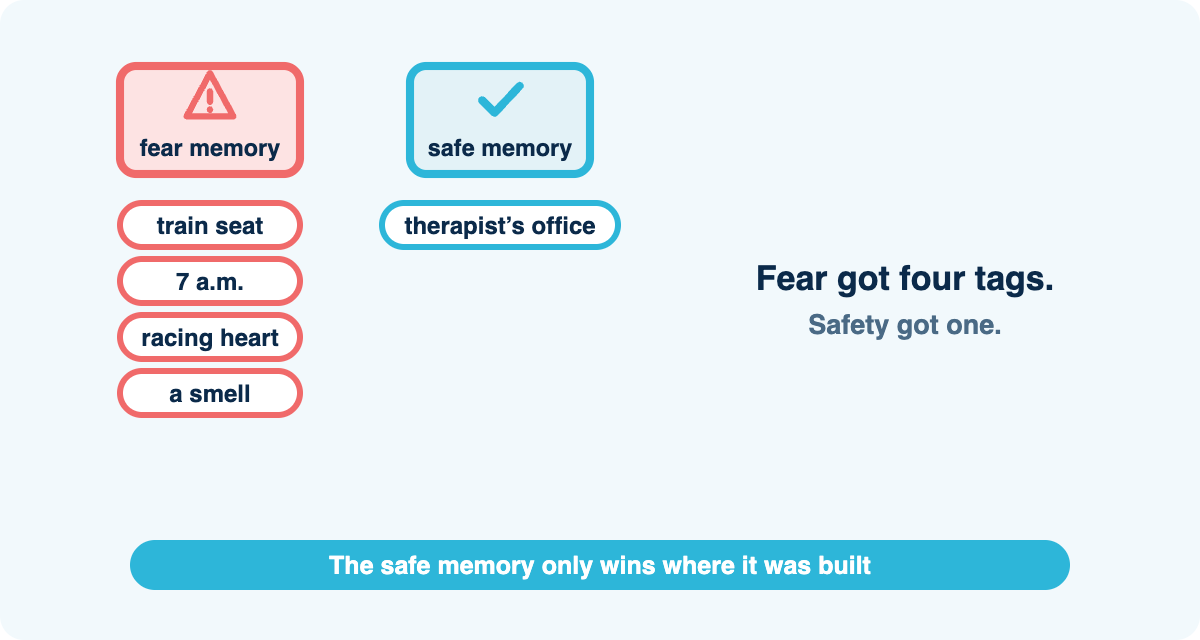
Researchers have a name for fear returning in a new setting: renewal (Bouton et al., 2006). The therapy did its job in one room. The safe memory just hasn’t been built anywhere else yet.
Build the safe memory everywhere the fear already lives. Practice the same feared thing in many different settings:
Every new setting gives the safe memory another tag.
And if the fear shows up somewhere new, that’s simply the next place to practice.
Exposure usually goes better with a guide, especially when a fear is starting to shrink someone’s life. A licensed clinician can help pick which situations to practice, in what order, and how to keep going when the fear spikes. If anxiety keeps coming back no matter what you try, our anxiety treatment page explains other options.
Prefer to watch? The short is above, or watch it on YouTube.
Educational information only, not medical advice. If you are in crisis, call or text 988.